What a photobooth business costs to start: equipment and budget
Starting a self-service photobooth runs from about Rp12,5 million for the leanest build to roughly Rp49 million for a high-end one. Almost all of that spread comes down to three things: the camera, the printer, and the enclosure. Here is the breakdown by component, and why buying the cheapest option does not always save money.
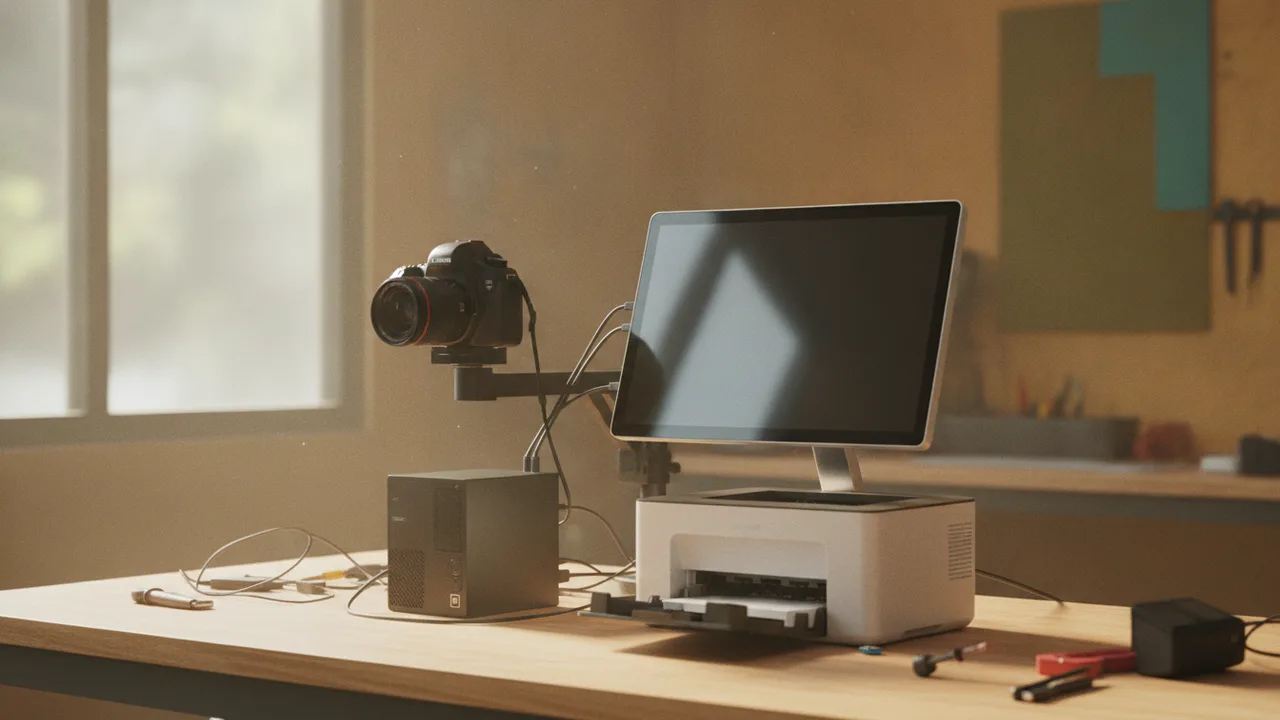
The camera is what the customer actually sees
A used entry-level DSLR or mirrorless body is enough for a booth. What matters is not resolution but connection stability over long hours: a booth shoots hundreds of times a day, and a camera that drops its connection every twenty sessions costs more in operator time than the price difference ever saved.
Canon is the most stable option in the field and Nikon is stable with some caveats. A webcam works for testing and for low-cost booths, but the print looks different and customers notice.
The printer is a running cost, not a one-time cost
A dye-sublimation printer such as the DNP DS-RX1 costs more up front, but the cost per sheet is low and the print is dry instantly. A photo inkjet is cheaper to buy, yet ink cost per print is higher and the sheet needs drying time — a real problem when a queue forms.
Work out the cost per print before choosing. At fifty prints a day, a Rp1.000 difference per sheet becomes Rp1,5 million a month — which overtakes the difference in printer price within months.
Software decides whether the booth can be left alone
Capture software alone is not enough for a self-service booth. An unattended booth has to take payment, print, and record the takings by itself. If any one of those is missing, somebody has to stand there — and that person's cost never appears in a startup budget, even though it is the largest number in it.
What each part costs
| Item | Indicative range | Notes |
|---|---|---|
| DSLR or mirrorless camera | Rp3.000.000 – Rp12.000.000 | Used entry-level up to a new mirrorless body. Canon is the most stable. |
| PC or mini PC | Rp3.500.000 – Rp8.000.000 | Windows 10/11 64-bit. A mid-range processor is enough; 8 GB RAM minimum. |
| Touchscreen monitor | Rp1.500.000 – Rp4.500.000 | 21–27 inch. A capacitive touch panel is far more comfortable for guests. |
| Photo printer | Rp2.500.000 – Rp12.000.000 | Photo inkjet at the low end; dye-sublimation such as the DNP DS-RX1 at the high end. |
| Enclosure and frame | Rp1.500.000 – Rp10.000.000 | Self-built up to a finished enclosure with proper lighting. |
| Lighting, cabling and sundries | Rp500.000 – Rp2.500.000 | Lighting is the most underestimated item and the most visible in the result. |
| Total, low to high | Rp12.500.000 – Rp49.000.000 |
Ranges are indicative for the Indonesian market and move with stock and exchange rates. Subscription software is not in the table because it is a monthly cost rather than startup capital — see the pricing page for that. Prices checked: 2026-08-18.
Common questions
What is a realistic minimum budget?
Around Rp12,5 million for a self-built rig with a used camera, a photo inkjet and a homemade enclosure. Below that, something is usually cut to the point where the booth can no longer be left unattended.
How long until the investment is repaid?
It depends on location and price per session, so no honest figure can be promised. What decides it is sessions per day rather than the size of the investment — which is why placement matters more than specification.
Do I need a dye-sublimation printer from the start?
Not necessarily. Start with a photo inkjet while volume is low, then work out the cost per print after a month. Past roughly 40–50 prints a day, dye-sublimation usually becomes cheaper within months.
Does software count as startup capital?
No — it is a monthly per-device subscription. A free tier is available so the full flow can be tested before any hardware is bought.
Software is the part you can try first
Before buying any hardware, the free tier runs the whole flow in a browser using a laptop webcam — welcome screen, capture, result.